November 2026 has brought several important developments in AI-powered search and discovery.
From OpenAI introducing Business Hub to Google’s improvements in query fan-out, platforms are changing how businesses appear, how information is retrieved, and how users discover products and services.
At the same time, new research from Peec AI and Goodie highlights an important challenge for marketers: AI visibility is becoming more complex to measure, particularly when AI-generated answers do not always include external citations.
This month’s developments are worth watching because they affect more than traditional search rankings. They influence brand discovery, product research, third-party credibility, website accessibility, and the measurement of AI search performance.
Here are five major AI search updates from November 2026 and their implications for SEO and GEO professionals.
1. OpenAI Introduces Businesses in ChatGPT and Business Hub
Announcement date: November 10, 2026
OpenAI introduced Businesses in ChatGPT, alongside Business Hub, a dedicated workspace that allows businesses to manage their presence and access visibility-related insights.
 OpenAI’s official walkthrough of Businesses in ChatGPT and Business Hub (Nov 10, 2026) — Click image to watch on YouTube.
The announcement introduces three important capabilities.
Business Information Management
Businesses can claim and verify profiles, update company information, and provide product feeds containing details such as pricing and availability.
Business Visibility Insights
Businesses can access aggregated information about:
- Brand mentions in ChatGPT.
- Website clicks.
- Discovery topics associated with their website citations.
Business Agents
Eligible US ecommerce and online service businesses can deploy dedicated Business Agents to assist customers through clearly labelled conversations.
Why this update matters for GEO
Until now, marketers have largely depended on third-party GEO platforms, manual prompt testing, referral analytics, and server-log analysis to understand their ChatGPT visibility.
Business Hub introduces another first-party measurement layer.
However, marketers should distinguish between brand mentions, website citations, clicks, and actual business conversions.
A company appearing in an AI-generated answer does not necessarily mean its website received a citation. Similarly, a website click does not guarantee a qualified lead.
My observation: This is an important development for AI visibility measurement. Business information management and first-party engagement insights could become additional components of a company’s GEO strategy.
2. Google Introduces Gemini 4 Hydrogen in Search
Announcement date: November 12, 2026
Google announced the global availability of Gemini 4 Hydrogen in Search, bringing improvements to how Search handles complex questions and multi-step reasoning.
One important area is query fan-out.
Instead of relying on a single search query, AI-powered search experiences can explore multiple related subtopics simultaneously to construct a more comprehensive answer.
Example: How query fan-out changes search
Consider a user asking:
“Which enterprise AI orchestration platform is best for insurance companies?”
The search experience may need to explore several related questions:
- What are the leading enterprise AI orchestration platforms?
- How do insurance companies automate claims processing?
- What governance and security controls are required?
- Which platforms support on-premise and private cloud deployment?
- How do AI agents integrate with legacy insurance systems?
Each question represents a different information requirement within the original search.
What SEO and GEO professionals should understand
This creates an opportunity to move beyond individual keyword-focused articles.
Instead of publishing multiple thin articles targeting slightly different keyword variations, marketers should develop connected content that answers the important questions throughout a buyer’s research journey.
For enterprise SaaS companies, this could include:
- Product and platform pages.
- Technical documentation.
- Security and governance resources.
- Integration guides.
- Deployment comparisons.
- Customer implementation stories.
My observation: Query fan-out makes content coverage and information architecture increasingly important. The objective should be to provide useful answers across a topic rather than optimize every page around one isolated keyword.
3. Reddit Introduces Reddit Reviews
Announcement date: November 10, 2026
Reddit introduced Reddit Reviews, an experience that organizes product-related community discussions into structured review pages.
The initial rollout covers approximately 10,000 products across:
- Electronics.
- Health and beauty.
- Home and garden.
- Fashion.
Reddit Reviews brings together recurring opinions, product advantages, disadvantages, discussion themes, and alternatives while connecting users to original community discussions.
Why this matters for AI search visibility
AI search engines can use information from multiple sources, including:
- Reddit discussions.
- YouTube videos.
- Independent reviews.
- Industry publications.
- Customer feedback platforms.
- Official product documentation.
This means a company’s website is not the only source that can influence how its products are discovered and evaluated.
For example, someone researching an enterprise AI platform may want to understand its actual implementation experience, integration challenges, product limitations, and customer feedback rather than relying entirely on vendor marketing.
What brands should do
Businesses should focus on building genuine third-party credibility through:
- Transparent technical documentation.
- Honest product comparisons.
- Real customer implementation stories.
- Verifiable product capabilities.
- Useful participation in relevant industry discussions.
My observation: Reddit Reviews reinforces the importance of off-site brand credibility. GEO is not just about optimizing your own website; it also involves understanding how independent sources contribute to product discovery and evaluation.
4. Peec AI’s Q3 2026 Report Highlights the AI Search ROI Gap
Report: Primary Sources – Q3 2026
Peec AI published its Primary Sources: Q3 2026 report, examining how marketing teams are investing in AI search and measuring its business impact.
The report combines a survey of 700 marketing decision-makers with platform retrieval analysis.
Important findings
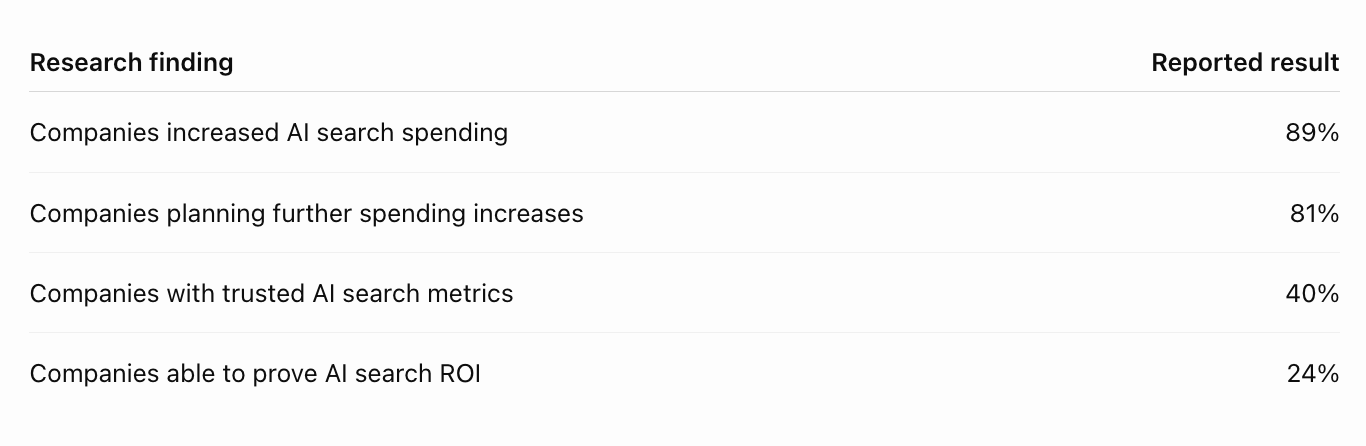
The findings reveal a considerable gap between AI search investment and measurement maturity.
What separates companies reporting stronger ROI?
The report identifies three organizational patterns.
Integrated strategy
Companies integrating AI search into their broader marketing strategy reported a 43% ROI proof rate, compared with 23% among companies with siloed strategies.
Dedicated ownership
Companies with dedicated full-time AI search owners reported a 35% ROI proof rate, compared with 15% among companies without dedicated ownership.
Dedicated tooling
Companies using specialized AI visibility platforms reported a 39% ROI proof rate, compared with 24% among those not using such platforms.
These are reported associations, not proof that any single organizational practice causes higher ROI.
Why this matters for marketers
AI search visibility should not be measured through citation counts alone.
A company may receive hundreds of AI brand mentions without generating qualified traffic or commercial opportunities.
A more complete GEO measurement strategy should connect:
- Brand visibility.
- Citation frequency.
- Positioning accuracy.
- AI referral traffic.
- Qualified demo requests.
- Marketing-influenced pipeline.
My observation: The next stage of GEO maturity will involve connecting AI discovery metrics with business performance. Marketing teams need to move beyond reporting how often their brands appear and understand whether that visibility contributes to customer acquisition.
5. AI Search Retrieval Changes: Multi-Query Fan-Out and Zero-Source Answers
Two findings from November-related research highlight why traditional AI citation tracking needs to evolve.
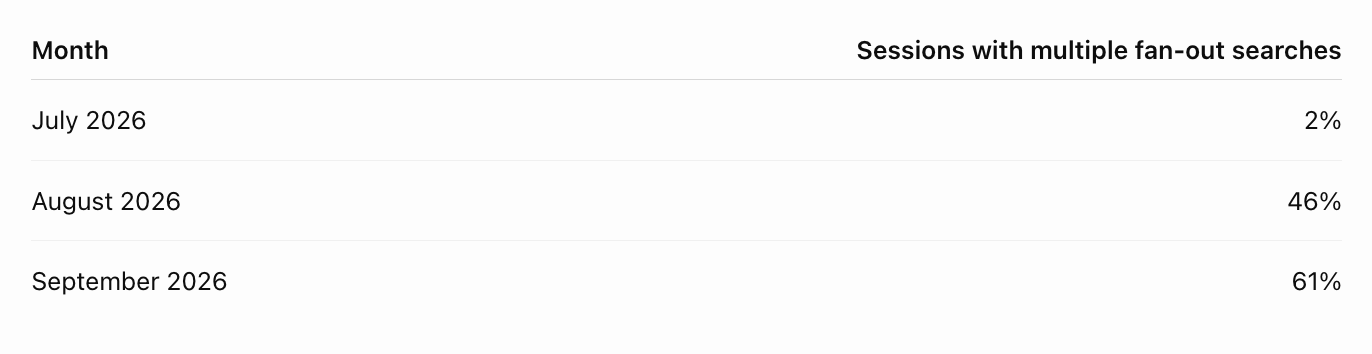
A. ChatGPT’s multi-query fan-out increased in Q3 2026
According to Peec AI’s Q3 report, the proportion of tracked ChatGPT sessions running multiple fan-out searches increased significantly.
The report also identified changes in search modifiers.
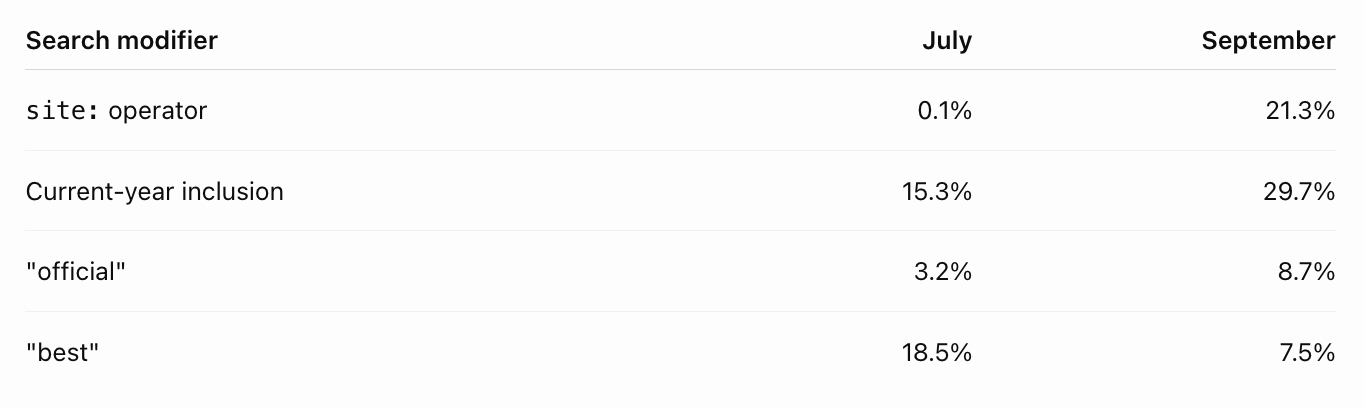
These findings suggest changes in the types of searches being conducted during AI-powered research.
Peec AI also reported differences in citation patterns between ChatGPT, Google AI Overviews, and Claude.
GEO takeaway: Different AI platforms can rely on different source types. Marketers should monitor platform-specific visibility rather than assuming that success in one AI search experience guarantees visibility in another.
B. Goodie Reports an Increase in Zero-Source ChatGPT Answers
Research date: November 12, 2026
Goodie published research on ChatGPT’s zero-source answers, analyzing 94,851 tracked responses.
Its findings showed that answers without external citations increased from 1.5% to 12.2% overnight on October 31.

Goodie suggests this may reflect changes in ChatGPT’s search and answer-generation behavior. However, this explanation should be treated as an interpretation of its observed data, not a confirmed statement from OpenAI.
Why zero-source answers matter
Traditional GEO monitoring often focuses on whether a brand receives a citation in an AI-generated answer.
But what happens when an AI system answers a question without displaying external links?
Citation tracking alone cannot describe every aspect of brand visibility.
Marketers should distinguish:
- Brand mentions: Whether the brand appears in an answer.
- Citations: Whether the website is referenced through an external link.
- Representation: Whether the AI system describes the brand accurately.
- Engagement: Whether the answer generates website visits or other interactions.
A missing citation does not establish that the brand was absent from the model’s internal reasoning. Likewise, a brand mention does not prove that external retrieval occurred.
My observation: AI visibility measurement needs to become more comprehensive. Citation tracking remains useful, but marketers should also monitor mentions, positioning accuracy, and engagement.
6. What These November Updates Mean for SEO and GEO Professionals
Looking across these five developments, I see six practical priorities for marketing teams.
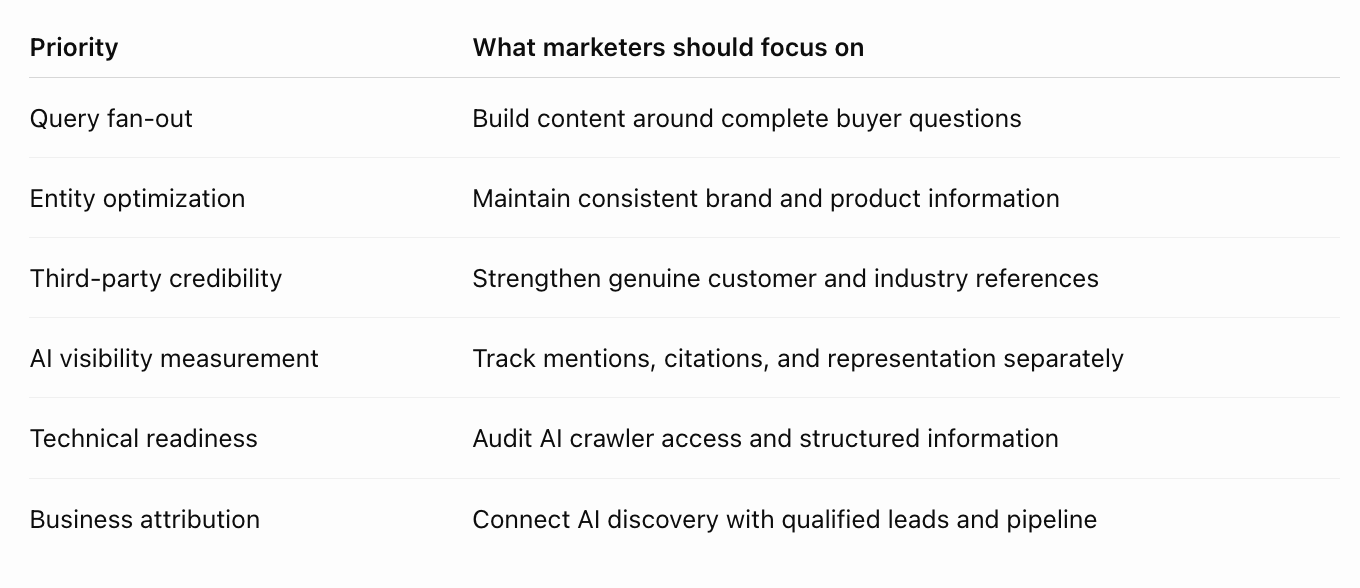
These are not separate marketing activities. They work together.
A technically accessible website with incomplete product information may still struggle to communicate its capabilities. A brand with strong website content but limited third-party credibility may also face challenges during product comparison and evaluation.
GEO requires a combination of content quality, entity clarity, external credibility, technical accessibility, and measurement.
7. The thatsaeobro Four-Layer GEO Measurement Framework
Based on these developments, I propose a four-layer framework for measuring AI search performance.
This is my own measurement model, not a framework published by Peec AI, OpenAI, Google, Reddit, or Goodie.
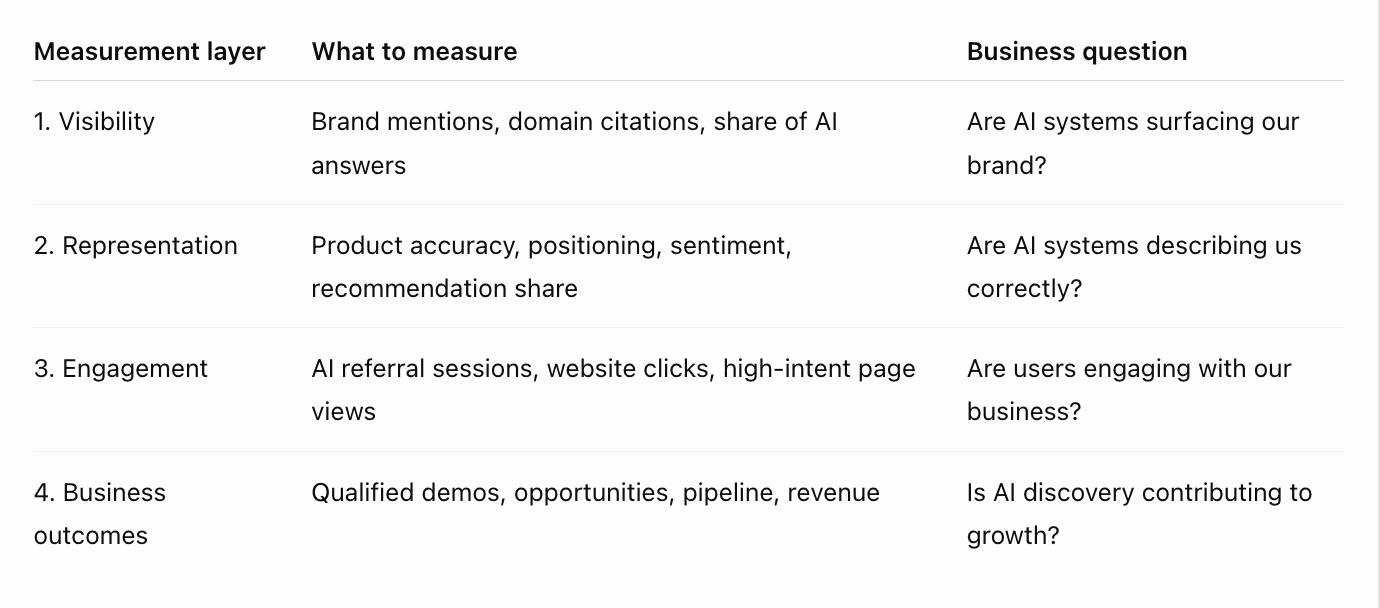
Why four separate layers matter
Consider an enterprise SaaS company that appears in ChatGPT responses for several product-related questions.
Its visibility may be increasing, but the brand might still be described inaccurately.
Even if the representation improves, the company needs to understand whether people visit its website and whether those visits contribute to qualified opportunities.
This is why GEO measurement should follow the complete discovery journey rather than focus on one isolated metric.
Final Takeaway: November Shows Why AI Search Measurement Is Changing
November 2026 has brought important developments across the AI search ecosystem.
OpenAI is introducing business-level visibility tools. Google is improving query fan-out in Search. Reddit is organizing product discussions into structured reviews. Peec AI’s research highlights the gap between AI search investment and ROI measurement, while Goodie’s findings raise questions about the reliability of citation-only tracking.
Together, these developments point towards a broader shift in digital discovery.
Traditional SEO rankings still matter, but they are no longer sufficient to describe how customers discover and evaluate brands.
For marketers, the challenge is to build brands that AI systems can discover, understand, represent accurately, and recommend when relevant.
The future of SEO is not just about ranking a webpage. It is about making your brand discoverable and trustworthy across the entire AI search journey.