Short answer: Yes. GEO (generative engine optimization) is a different goal from SEO, but AI search systems still rely on SEO fundamentals to find, understand and trust your pages before they cite them. GEO sits on top of SEO. It does not replace it.
TL;DR
- GEO vs SEO: SEO ranks pages in search results. GEO gets your content and brand cited or recommended inside AI-generated answers.
- Why SEO still matters: AI systems must fetch, understand, select and trust a page first. Each step maps to an SEO fundamental.
- The 7 fundamentals: technical SEO, crawlability, structured data, content quality, brand authority, entity consistency and external mentions.
- What is new in GEO: passage-level optimisation, citation tracking and coverage of fan-out queries.
- Where to start: confirm crawler access, check rendering, validate schema, align your brand description everywhere, rewrite top pages with direct answers, and test real prompts monthly.
There is a popular claim doing the rounds: “SEO is dead, GEO is the new game.” It makes a good headline. It does not hold up when you look at how AI search systems actually work.
Generative engine optimization (GEO) is a different discipline from classic SEO. The goal moves from ranking a link to being retrieved, understood and cited inside a generated answer. But the system that decides whether your page is even considered still depends on the foundations SEO has always cared about.
This guide covers where each fundamental still matters, what genuinely changes with GEO, and how to audit your site in a sensible order.
Is SEO Still Important for AI Search?
Yes. Before an AI search system can cite your page, it has to find it, fetch it, understand it and trust it. Each of those steps depends on an SEO fundamental:
- Find and fetch: technical SEO and crawlability
- Understand: structured data and entity consistency
- Select: content quality
- Trust: brand authority and external mentions
GEO changes what you optimise for (being cited in an answer). It does not change what has to be in place first.
Google said the same thing on stage. At Google Search Central Live in Bengaluru on 30 October 2026, one of the main slides was titled “Optimize for people to win in generative AI Search,” and its central line was that good SEO is good “GEO,” and that good SEO is largely about great content for people. The slide backed this with three points:
- Generative AI responses are grounded in Google’s search index. The slide said generative AI features are rooted in Google’s core Search ranking and quality systems.
- Retrieval starts from the same index. RAG and query fan-out pull relevant, up-to-date web pages for the original query and the related queries.
- The systems are durable. Optimising for generative AI features means optimising for what your audience needs
Author’s note: “I was in the room in Bengaluru when this slide went up, and it matched what I see in my own work. There is no separate shortcut for AI search. If a page is crawlable, clear, useful and trustworthy, it is eligible. GEO is what you build on top of that.”
Shanmugaraj Y , — SEO & AI Search Research, Thatsaeobro.com
What Is the Difference Between GEO and SEO?
In classic search, you compete for a position on a results page. In AI search (Google AI Overviews, AI Mode, ChatGPT search, Perplexity), the system takes a question, breaks it into several sub-questions, retrieves passages from many sources and composes one answer. Your page competes to be a source, not a blue link.
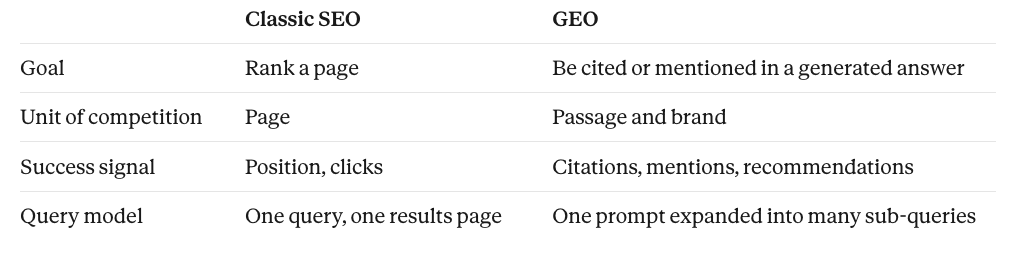
The difference is real. The dependency is also real, and the next sections show where.
Does Technical SEO Affect AI Overviews and ChatGPT Search?
It does, because technical SEO decides whether your page is a usable candidate at all. Slow pages, broken mobile layouts, heavy JavaScript that hides the main content, and inconsistent status codes all weaken a page’s chances of being retrieved.
What matters in practice:
- Server-side rendered or reliably rendered main content, so the answer is in the HTML a crawler receives
- Clean canonical tags, so signals are not split across duplicate URLs
- Fast, stable pages on mobile
- Correct status codes and clean redirect chains
A common mistake: teams invest in “AI-friendly content” while key pages sit behind client-side rendering that some crawlers never execute. The content is good. Nobody can read it.
Do AI Crawlers Respect robots.txt, and Can They Access Your Site?
Crawlability is now a two-part question: can search engines crawl you, and can AI crawlers?
Review your robots.txt for blanket rules that block newer AI user agents by accident. Check your WAF and CDN settings as well, because bot protection often blocks legitimate crawlers without anyone noticing. Keep a clean XML sitemap and strong internal linking so important pages are not orphaned.
Blocking an AI crawler can be a deliberate business decision. It should never be an accident.
Does Schema Markup Help You Get Cited in AI Answers?
Schema markup does not guarantee a citation. What it does is reduce guesswork. Organization, Article, FAQPage, Product, Person and BreadcrumbList markup tells a machine what a page is, who published it and how it connects to other entities.
Two rules worth following:
- Markup must match visible content. If the schema claims something the page does not say, you create a trust problem instead of solving one.
- Fewer types, implemented accurately, beat every type implemented loosely.
What Kind of Content Do AI Search Engines Cite?
AI systems rarely use a whole article. They lift passages. That changes what good content looks like:
- Lead each section with a direct answer, then add depth
- Keep one idea per paragraph so a passage stands on its own
- Use specific, verifiable details (numbers, named methods, dates) instead of generic statements
- Show first-hand experience: what you tested, what failed, what you would do differently
Generic content is the biggest risk. If your page says what ten other pages already say, a retrieval system has no reason to choose it. Original data, a clear point of view and real examples give a passage a reason to be selected.
Does Brand Authority Influence AI Search Results?
When several sources can answer a question, systems lean toward the ones that look established and dependable. Brand authority comes from consistent publishing on a defined topic, visible expertise on the page (named authors, credentials, a clear About page) and being known for something specific.
A brand that covers twenty unrelated topics reads as shallow. A brand that goes deep on one area reads as a source.
What Is Entity SEO and Why Does It Matter for GEO?
Search and AI systems think in entities: companies, people, products and concepts. They connect these across the web. If your company name, description, category and key facts vary between your website, LinkedIn, directories and review platforms, that connection weakens.
A simple audit:
- Use the same brand name, description and category language everywhere
- Align your website, LinkedIn page, business directory profiles and review-site listings
- Link your Organization schema to your official profiles using sameAs
- Keep product names and feature descriptions consistent across pages
It is unglamorous work, and one of the cheapest improvements available.
How Do Third-Party Mentions Shape What AI Recommends?
Your own site is only one input. AI answers draw heavily on third-party context: review platforms, community discussions, industry publications, comparison pages, podcasts and YouTube. Being mentioned accurately and repeatedly in credible places influences whether a system recommends you.
Practical ways to earn them:
- Publish original research others want to reference
- Contribute expert commentary to industry publications
- Keep review-site profiles complete and current
- Take part honestly in communities where your audience asks questions
Do not manufacture mentions. Inconsistent or low-quality ones can hurt more than they help.
How SEO Fundamentals Map to AI Search Visibility
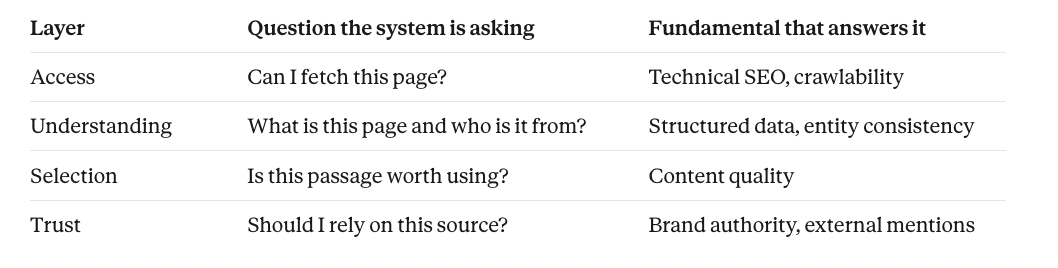
If any layer is weak, the layers above it cannot compensate.
What Changes With GEO That SEO Never Covered?
To be fair to the “GEO is separate” argument, some things are new:
- You optimise for passages and answers, not only pages and rankings
- Visibility is harder to measure, so tracking citations and mentions across prompts becomes part of the job
- Query coverage matters more, because one prompt expands into many related searches
That last point has the biggest content impact.
What Is Query Fan-Out and How Should You Write for It?
When someone asks an AI search system a question, it often runs several related searches behind the scenes. This is called query fan-out. Writing only for the visible question leaves gaps.
For this topic, related sub-queries might include:
- Is SEO still important for AI search?
- GEO vs SEO: what is the difference?
- Does technical SEO affect AI Overviews?
- Do AI crawlers respect robots.txt?
- Does schema markup help get cited in AI answers?
- How do brand mentions influence AI search results?
- What is entity SEO and why does it matter for GEO?
- Why does my site rank on Google but not appear in AI answers?
A page that answers several of these clearly, in separate sections, has more chances to be retrieved than a page that covers the topic once in broad terms. This is why the headings in this article are written as questions.
Why Does My Site Rank on Google but Not Appear in AI Answers?
Ranking and citation are separate decisions. A page can rank well for its target query and still be skipped. The usual causes:
- The passage is not self-contained. The answer depends on context from elsewhere on the page, so it cannot be lifted cleanly.
- The brand is not corroborated elsewhere. The system finds little third-party support for what you claim.
- Sub-queries are unanswered. The prompt expanded into questions your page does not address.
- Crawler access is blocked. An AI user agent is blocked at robots.txt, the WAF or the CDN.
Check these four before assuming a deeper technical fault.
How Do You Check and Improve Your Visibility in ChatGPT Search?
Do not start by rewriting everything. Work through this order:
- Confirm crawler access. Make sure search and AI crawlers can reach your key pages.
- Check rendering. Verify the main content is present in rendered HTML.
- Validate schema. Confirm markup matches visible content.
- Align your entity. Use one brand description across every profile.
- Rewrite top pages. Make each section open with a direct answer.
- Map third-party sources. List the platforms your audience trusts and work on being present there.
- Test real prompts. Run your target questions in ChatGPT search, Google AI Mode and Perplexity, and record which sources and brands appear.
Repeat step 7 monthly. Prompts and results shift, so a single check tells you little.
Final Verdict: SEO Is the Foundation, GEO Is the Next Layer
GEO adds a new goal, but it does not change the supply chain. Pages still need to be reachable, understandable, useful and trusted. Teams that treat GEO as a reason to abandon fundamentals will lose visibility in both worlds. Teams that treat it as an extension of strong SEO will be well placed in both.
FAQs
Is SEO still important for AI search? Yes. AI systems still depend on crawlable, indexable, trustworthy pages. SEO fundamentals are what make a page eligible to be cited.
What is the difference between GEO and SEO? SEO aims to rank pages in search results. GEO aims to get your content and brand cited or recommended inside AI-generated answers. GEO builds on SEO.
Does schema markup help with AI Overviews? It helps machines understand your page and entities, but it does not guarantee citation. Accurate markup that matches visible content is the safest approach.
Can I block AI crawlers and still do GEO? Blocking AI crawlers limits what those systems can retrieve from your site, so it reduces your chances of being cited by them. Treat it as a deliberate decision, not a default.
How often should I check my AI search visibility? Monthly is a practical cadence, using a fixed set of target prompts so you can compare results over time.